
Names
Names Ancestry can find
Surnames in ALL CAPS, the setting Ancestry search matches most reliably. Nicknames and alternate surnames in double quotes, because Ancestry does not index parentheses. Suffixes from one approved list.
Why it matters
One day a grandchild, a cousin, or a new DNA match will open your tree with no one beside them to explain it. What they find is what you leave: the names, the dates, the places, and the evidence behind them.
What the next reader inherits
Years of work live in a tree that was typed in a hundred sittings, from a hundred sources, each with its own spelling and date style. Canopy brings that record to one standard and checks it, so the person who comes after you can search it, follow it, and trust it.
Names
Surnames in ALL CAPS, the setting Ancestry search matches most reliably. Nicknames and alternate surnames in double quotes, because Ancestry does not index parentheses. Suffixes from one approved list.
Dates
Every date as DD Mon YYYY, with Abt, Bef, Aft, and Between kept. Optional settings convert Quaker numbered months and Old Style dual years, so 1 Jan 1750/51 reads as 1 Jan 1751.
Places
US places as City, County, State, United States, with missing counties filled in from a database of more than 164,000 entries. Canadian places as Municipality, MRC or county, Province, Canada.
Timeline Analysis tests each person against 19 rules — a death before a birth, a child born after the mother died, a marriage before age 14 — so impossible facts are caught while you still remember the source.
The Profile Quality Star scores how complete and well-evidenced each person is, from 0 to 100: birth and death dates, sources, timeline events, and relationships. A reader can see at a glance which profiles are well documented and which still need work.
The kinship badge marks blood relatives with a red drop and everyone else with a numbered step pill. Relationship Finder names the closest blood or marriage connection between any two people in the tree.
A ready legacy
You spent a lifetime growing the tree. Leave them the canopy to gather beneath.
Prune Distant Branches removes distant non-blood profiles one Kinship Tier ring at a time, while blood relatives and anyone tagged Do not delete stay protected.
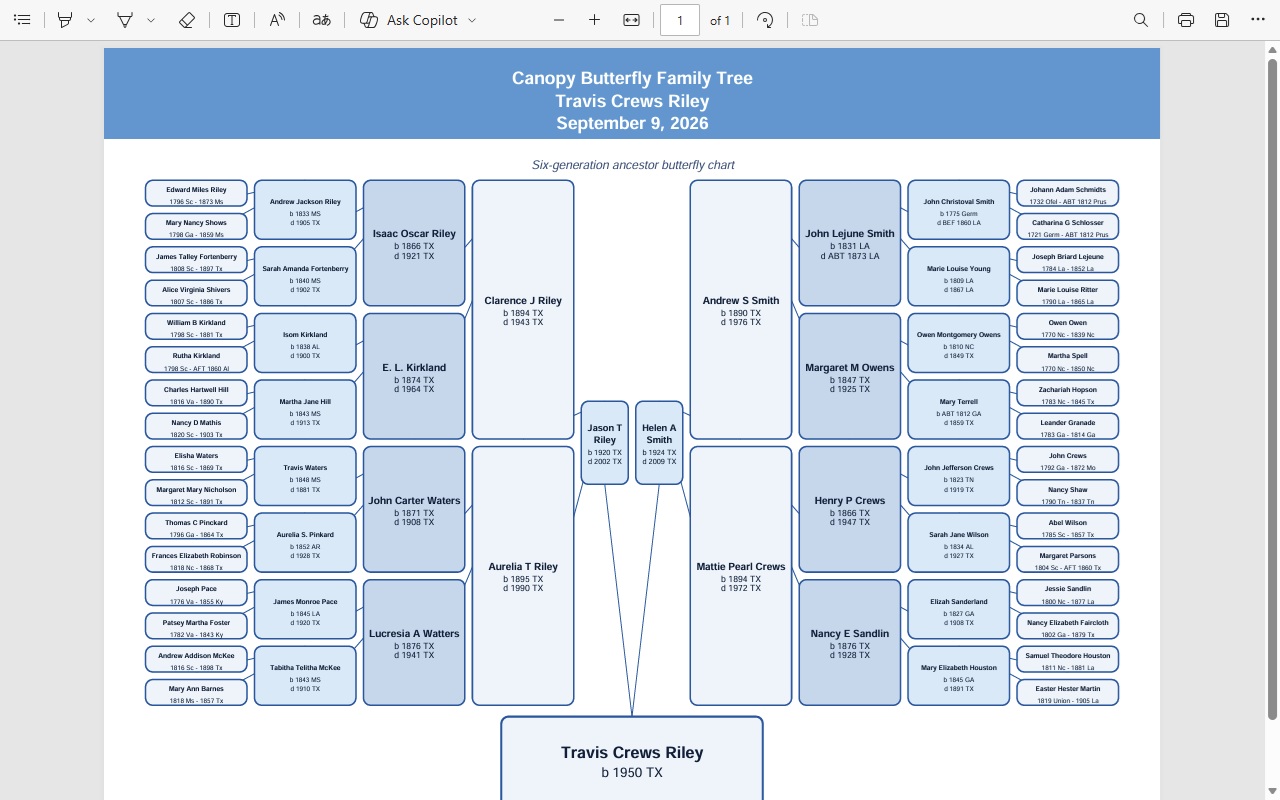
Butterfly and fan charts, registers, and Family Group Sheets, saved as PDFs you can print, frame, and pass along.
Every GED batch run offers a change log of each field it changed, with the original value beside the formatted one, to keep with your research.
Begin with one family
Open your own profile or a grandparent’s and click ✦ Format Family. Every family member shown on the profile is formatted to your preferences, and the Format Report lists each change so you can undo any field you want to keep as it was.
Then import your GEDCOM and print the Butterfly chart for the same person. That page, and the tree behind it, is what the next generation will open.
Get Canopy
Seven days free, no credit card. Then $69.95 a year for every report and tool.